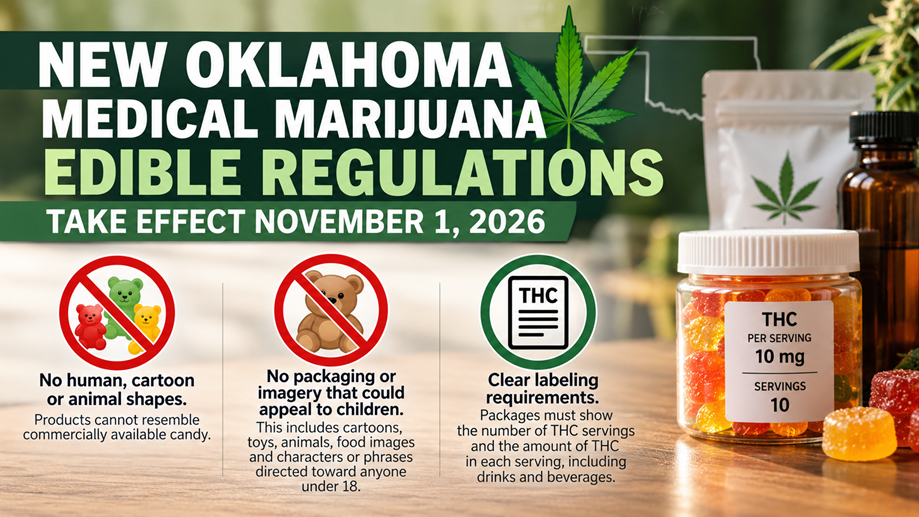
OKLAHOMA CITY – New regulations governing the appearance, packaging and labeling of edible medical marijuana products in Oklahoma will take effect November 1, 2026.
Under House Bill 4454, edible medical marijuana products can no longer be manufactured in the shape of humans, cartoon characters or animals. Products also cannot resemble commercially available candy.
The legislation is designed to reduce the risk of accidental ingestion by children while providing consumers with clearer information about THC content and serving sizes.
New Packaging and Labeling Requirements
The law prohibits edible marijuana products from using images, words or designs that could appeal to anyone under the age of 18.
This includes packaging featuring cartoons, toys, animals, food imagery, depictions of minors or characters and phrases commonly used in advertising directed toward children.
The restrictions are intended to prevent medical marijuana products from being mistaken for ordinary candy or other snacks.
THC Content Must Be Clearly Labeled
In addition to appearance restrictions, the law requires edible medical marijuana products to clearly identify:
-
The number of THC servings contained in each package.
-
The amount of THC in each individual serving.
-
Serving information for marijuana-infused drinks and beverages.
These requirements are intended to help patients better understand dosage amounts and reduce the risk of consuming more THC than intended.
Enforcement and Penalties
House Bill 4454 amends existing Oklahoma law and does not establish additional penalties for licensed medical marijuana processors.
Processors remain subject to inspections by the Oklahoma Medical Marijuana Authority (OMMA), which may conduct up to two inspections annually.
Businesses found to be in violation of regulations have 30 days to correct deficiencies. Failure to comply can result in fines of $500 per deficiency.
Oklahoma’s Medical Marijuana Program
Oklahoma voters legalized medical marijuana in 2018 through State Question 788, a citizen-led initiative petition.
The new regulations are part of ongoing efforts to strengthen consumer protections and improve safety within the state’s medical marijuana industry, particularly when it comes to preventing accidental exposure among children.