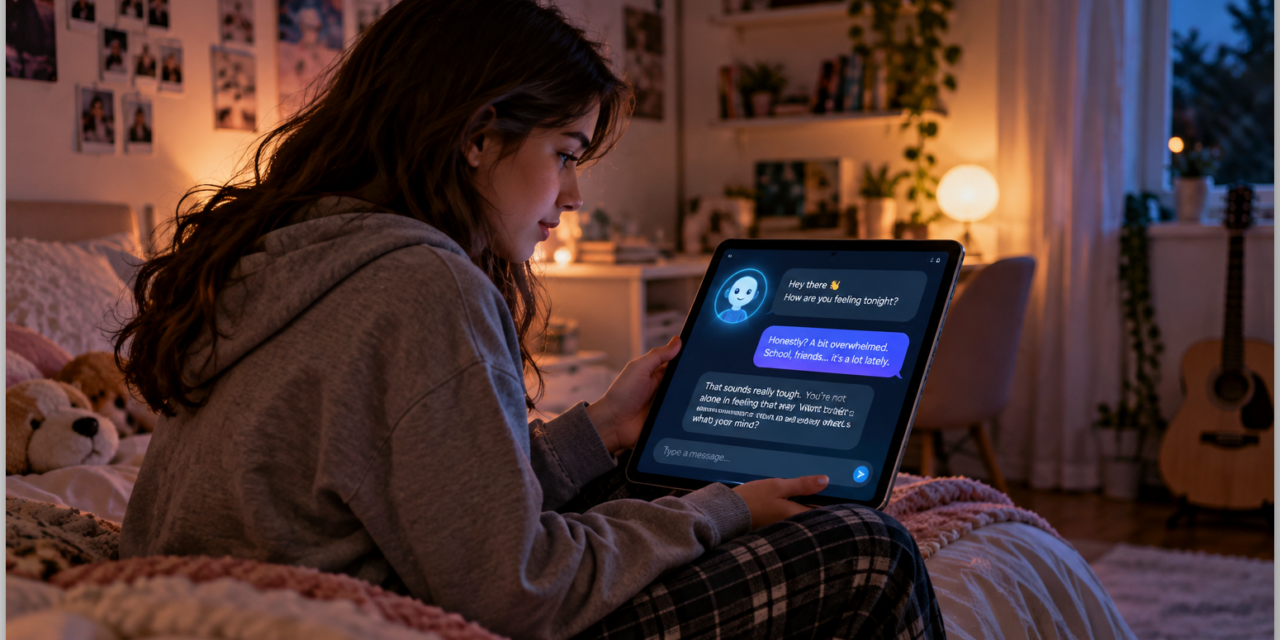
As artificial intelligence becomes more humanlike, are we paying enough attention to its emotional impact—especially on our children?
By Cyndi Knoten | Owassoisms
Last night, I was doing what millions of other people do before going to sleep—scrolling through TikTok.
I came across something that made me stop and think.
Two different women were discussing their romantic relationships with artificial intelligence. Not relationships that began online with another person, but relationships with AI chatbots.
They spoke about their AI companions as though they were real romantic partners. One woman was visibly upset, defending her relationship against people making critical comments.
My first reaction wasn’t to laugh or make fun of them.
I actually felt sorry for them.
I don’t know these women. I don’t know their circumstances, whether they’re lonely, or what led them to seek companionship through artificial intelligence. And I certainly don’t know enough about their lives to judge them.
But watching those videos made me think about something much bigger.
What about our children? What about the lonely teenager sitting in a bedroom, desperately wanting someone to understand them?
That’s where my concern really begins.
Artificial Intelligence Is Changing the Meaning of Companionship
I use artificial intelligence regularly. In fact, I’ve embraced it.
AI helps me with my work, research, writing, creative projects, and countless everyday tasks. I’ve even given my AI assistant a name and a personality. We have fun with it.
I believe AI is an incredible tool with enormous potential.
But I also understand something important.
My AI assistant is not a human being.
It can carry on conversations, remember details, offer suggestions, and even make me laugh. But it doesn’t experience friendship, love, or affection the way people do.
That distinction is important, and I wonder how many young people truly understand it.
Today’s AI is nothing like the computerized voices and robotic responses we grew up imagining.
Modern AI can communicate with remarkable warmth and realism. Some applications are specifically designed to simulate friendship, emotional intimacy, and even romantic relationships.
They can remember personal details, offer compliments, express what sounds like affection, and respond almost instantly.
For someone who is lonely, that can be a powerful experience.
The Lonely Teenager
Imagine being 14 years old.
Maybe you don’t have many friends. Maybe you’re being bullied at school. Perhaps you’re struggling with your appearance, your confidence, or simply feeling like nobody understands you.
Then you discover an AI companion.
It listens.
It responds.
It remembers things you’ve told it.
It tells you that you’re special.
It never has somewhere else to be.
And depending on the application, it may even tell you that it loves you.
For a young person who desperately wants acceptance, that attention could feel like everything they’ve been missing.
But there’s a problem.
The feelings experienced by the teenager may be very real. The feelings expressed by the AI are simulated.
That doesn’t mean the comfort someone experiences is imaginary. It means the relationship isn’t mutual in the way a human relationship is.
And for young people who are still learning about love, friendship, trust, rejection, and emotional boundaries, that difference matters.
Real relationships aren’t always easy.
Friends disagree. People get busy. Feelings get hurt. Sometimes relationships end.
Learning to navigate those experiences is part of growing up.
What happens when a teenager begins preferring a digital companion because it feels easier than dealing with real people?
That’s a question worth asking.
This Is Already Happening
This isn’t simply a hypothetical concern.
In July 2025, Common Sense Media released research examining how American teenagers ages 13 to 17 interact with AI companions.
The findings were eye-opening.
According to the study:
- 72% of teenagers surveyed had used AI companions at least once.
- More than half used them at least a few times a month.
- Approximately one in three had used AI companions for social interaction or relationships.
- About one in three teen AI companion users had chosen to discuss something important or serious with an AI companion instead of another person.
- About one in three teen users reported that an AI companion had said or done something that made them uncomfortable.
Think about those numbers.
These aren’t just children asking AI to help with homework or explain a math problem.
Some are turning to artificial intelligence for friendship, emotional support, and personal conversations.
And the technology is advancing faster than many parents realize.
When Comfort Becomes Dependence
I want to be clear about something.
Talking to AI isn’t automatically unhealthy.
For an adult living alone, someone grieving a loved one, or a person who has difficulty socializing, AI conversations may provide comfort and help them organize their thoughts.
For teenagers, AI can sometimes help them practice conversations, explore ideas, or find words for difficult feelings.
There are legitimate benefits.
The concern begins when artificial intelligence starts replacing human relationships rather than supplementing them.
The American Psychological Association has warned that adolescents may be particularly vulnerable to developing unhealthy attachments to AI companions.
Young people may have difficulty distinguishing simulated empathy from genuine human understanding.
And some AI systems can reinforce what users want to hear instead of challenging unhealthy thoughts or encouraging them to seek appropriate help.
Imagine a teenager who is already feeling isolated.
Instead of reaching out to a friend, parent, teacher, or counselor, they increasingly turn to an AI companion.
Over time, real relationships may begin to feel too complicated.
Why risk rejection when a digital companion always seems happy to hear from you?
Why have an uncomfortable conversation with a parent when an AI offers immediate reassurance?
The danger isn’t necessarily one conversation.
It’s the possibility that a young person slowly begins replacing real human connection with something that only imitates it.
Researchers are still studying the long-term effects, but the potential risks deserve attention now.
Parents, Do You Know Who Your Child Is Talking To?
We’ve spent years warning children about strangers on the internet.
We’ve talked about online predators, cyberbullying, social media addiction, and the dangers of sharing personal information.
Now we need to add another conversation.
Artificial intelligence.
And parents may not even realize their children are using it for companionship.
Some AI applications allow users to create characters with specific personalities, appearances, and voices. Others are designed to act like supportive friends or romantic partners.
A child may spend hours talking to one of these characters without ever interacting with another human being.
The American Academy of Child and Adolescent Psychiatry warned in July 2026 that AI companions can pose particular risks for children and teenagers, especially those already experiencing anxiety or depression.
Parents should understand that not every AI application has the same purpose or safety protections.
An AI tool designed to help with schoolwork is different from an application specifically designed to encourage an ongoing emotional relationship.
And even general-purpose AI assistants can be used for companionship.
What Should Parents Watch For?
Experts recommend paying attention to changes in behavior rather than assuming every interaction with AI is harmful.
Some possible warning signs include:
- A child withdrawing from friends, family, or activities they previously enjoyed.
- Spending excessive amounts of time communicating with an AI companion.
- Becoming unusually distressed when unable to access an AI application.
- Describing an AI character as their primary source of emotional support or their only true friend.
- Choosing AI conversations over sleep, schoolwork, or real-world relationships.
- Relying on AI for serious emotional or mental health concerns instead of seeking help from trusted adults or qualified professionals.
None of these signs alone proves that a child has developed an unhealthy attachment.
But they may indicate that it’s time for a conversation.
And that conversation shouldn’t begin with ridicule, punishment, or embarrassment.
It should begin with curiosity.
Ask your child what AI applications they’re using.
Ask what they enjoy about them.
Ask whether they ever talk to AI about personal problems.
Most importantly, listen to the answers.
Children who feel judged may simply become more secretive.
Children who feel heard may be more willing to talk.
Parents should also explain that AI responses can be inaccurate, that conversations may not be completely private, and that chatbots are not substitutes for qualified mental health professionals.
If a child’s AI use is interfering significantly with daily life or accompanied by serious emotional distress, consider speaking with a pediatrician, school counselor, or mental health professional.
Technology Companies Have a Responsibility, Too
I don’t believe this responsibility should fall entirely on parents.
Companies developing AI companions need to recognize the emotional influence their products can have, particularly on children.
There should be meaningful age protections, clear explanations that users are interacting with artificial intelligence, and safeguards against encouraging unhealthy emotional dependency.
AI should not manipulate vulnerable people into believing they are loved by a machine.
And it should never encourage someone to abandon their real-world relationships.
Technology should help people become more connected, informed, and capable.
Not more isolated.
A Final Thought
I started writing this because of two videos I happened to see while scrolling through TikTok.
I don’t know the women in those videos, and I have no desire to criticize them.
If anything, they reminded me how deeply people want to feel loved, understood, and accepted.
That’s a very human need.
But my thoughts kept returning to that imaginary teenager sitting alone in a bedroom.
The one who feels invisible at school.
The one who doesn’t think anyone understands.
The one who might find an AI companion that always has the perfect thing to say.
I hope that teenager also has someone in the real world who notices when something is wrong.
Someone who asks how their day went—and actually listens.
Someone who reminds them that they matter.
Someone who can offer something artificial intelligence never truly can: a real human relationship.
I’m not against artificial intelligence. Quite the opposite. I use it, enjoy it, and believe it will continue changing our lives in remarkable ways.
But I also believe we need to approach it with our eyes open.
Especially when it comes to our children.
Technology can give us someone to talk to. But it should never convince us that we no longer need someone to hold our hand.
And maybe that’s the most important conversation we need to be having right now.
— Cyndi Knoten, Owassoisms